
A young player tried an early build of our lessons. The screen asked for a C. They knew what a C was. They had no idea where it lived on the keyboard, and they called the whole thing ragebaiting. Fair.
That gap, between knowing a fact about music and doing it with your hands, is what the lessons in MidiSlayer are built around. Before we wrote a single step, we read the research: studies on practice, on rhythm, on how people learn to read music, and on how to teach anything without drowning the learner. This post is what we found and what we did with it.
We didn't want lessons that feel clever. We wanted lessons that work, and we wanted to be able to say why.
One honest note first. Music-learning research is thinner than you'd hope. A lot of it is small studies, some of it is on clarinet players or university students rather than adults at a keyboard, and some findings come from general learning research, not music. We say which is which below, and the references at the end let you check us.
1. One idea at a time
The finding. Breaking a lesson into short segments, each with one job, helps people learn it. A 2019 meta-analysis pooled 56 studies of "segmenting" and found a reliable effect, small to medium in size, on both remembering the material and using it. Segmenting also lowered how overloaded learners felt (Rey et al., 2019).
What it means. Your working memory is small. If a step asks you to find a key, read a note and keep a beat at the same moment, something falls out.
What the lessons do. Every step in a MidiSlayer lesson carries one idea and one action: "D sits between the two black keys. Press it." If a step needs more than a line or two, it becomes two steps. Each lesson takes two to four minutes, and the Beginner stage is eleven of them plus a check.
2. Keys and pulse before the staff
The finding. A review of 14 peer-reviewed studies and 7 dissertations on beginning instrumentalists found that "sound before symbol" approaches, such as playing by ear, echoing and rote learning, went with better rhythm, ear-playing and sight-reading. Rhythmic accuracy improved with teaching that used no notation at all (Ausman, 2022). The author notes the research is limited.
What it means. Notation is a way of writing down things you can already do. Learn the thing first and the symbol has something to stick to.
What the lessons do. The Beginner stage teaches the keyboard first, then your hands, then the beat, then note lengths, and only then the staff. The very first lesson ends with a tune you hear and play back, no reading involved. Rhythm lessons happen on a single key, so the only new thing is time. The full order, day by day, is here.
3. Count the beat, and drill it
The finding. Two meta-analyses of sight-reading research found that, for rhythm, interventions built on a counting system plus movement or rhythmic drill helped. Changing how the notation looks did not help (Mishra, 2016). Smaller studies suggest no one counting system beats another; using one, consistently, is what matters.
What it means. Say "1 2 3 4", play against a real pulse, and keep the music looking like real music.
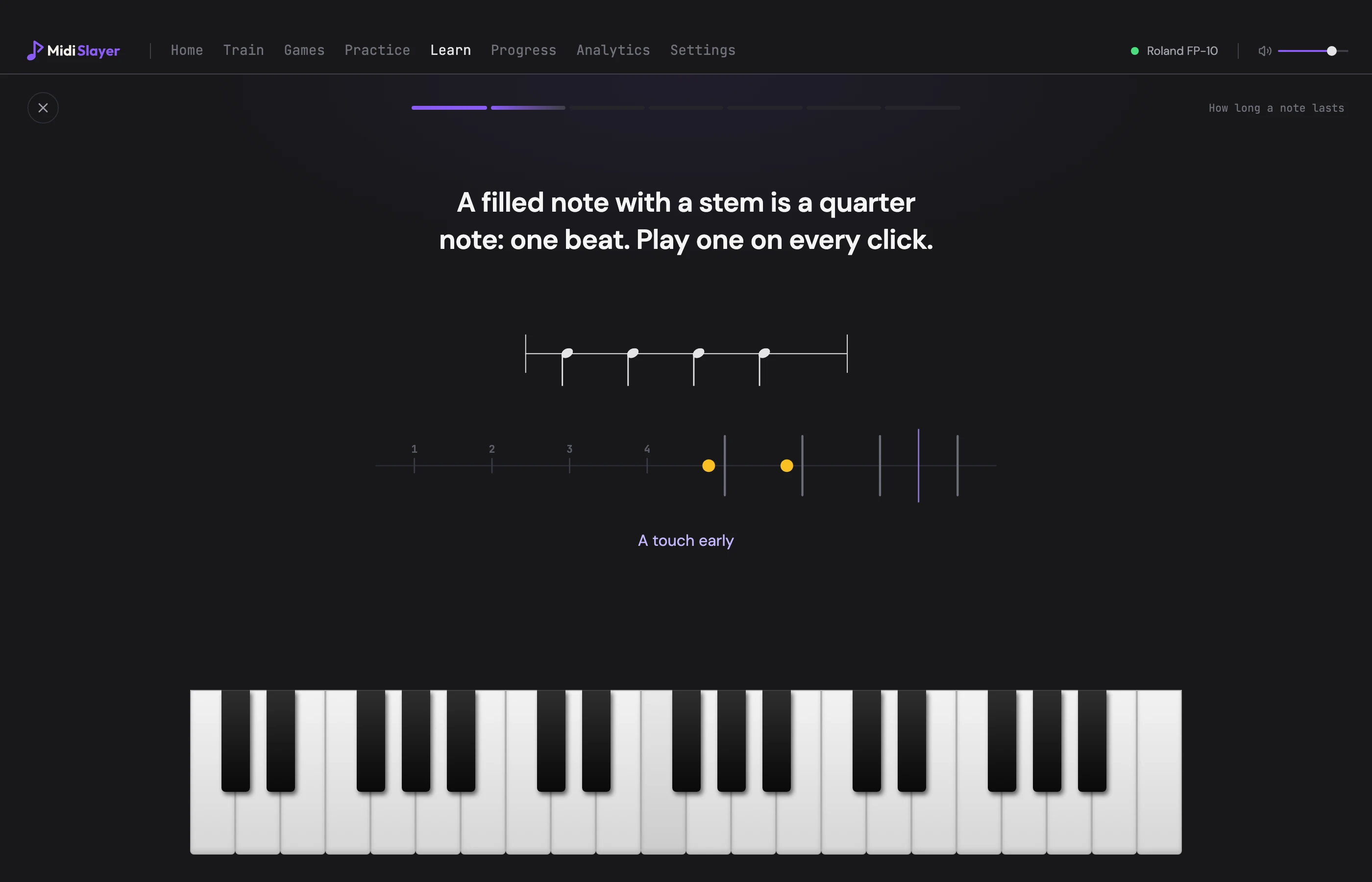
What the lessons do. Every rhythm step has a count-in and a click, with a higher click on beat 1 so you feel the bar. The lessons tell you to count, out loud if it helps, including through rests. The staff in a lesson looks like the staff in any printed book: no colours to unlearn later.
4. Practise it right, not just long
The finding. In a study of 17 advanced piano students learning a short, tricky passage, total practice time and number of repetitions did not predict how well they played it the next day. The strongest players found the exact spot that was going wrong and fixed it, and a higher share of their run-throughs were correct (Duke, Simmons and Cash, 2009). It is a small, correlational study, so read it as a strong hint, not a law.
What it means. Playing a mistake over and over rehearses the mistake. The useful repetitions are the correct ones.
What the lessons do. When you miss, the lesson tells you what you actually pressed. Miss the same step twice and it names the note it wants. Miss a third time and it lights the key. You're never left guessing, so most of your repetitions end up correct ones. In a run of notes, a slip keeps your place rather than sending you back to the start. And in every Train mode, "Show me where" lights the key and its black-key group after a miss or a pause, so the "I know it's a C, but where?" moment from the top of this post can't happen.
5. Sleep on it, then prove it
The finding. A beginners' study on clarinet compared practising one exercise at a time with mixing them up. At the end of practice the two groups looked the same. When retested later, the mixed group was clearly better, and the one-at-a-time group had slipped back (Stambaugh, 2011). Research from the same lab as the practice study above looked at sleep between sessions for a short keyboard melody (Simmons and Duke, 2006); reports of it describe better performance after a night's sleep.
What it means. How well you play at the end of a session is a poor guide to what you've learned. The test is tomorrow.
What the lessons do. The Beginner stage ends with a check that mixes everything up, gives no help at all, and only counts on a later day than your last lesson. Take it the same day and it's practice. You pass with three slips or fewer. That's one reason the lessons are short: ten minutes a day beats a long weekend session.
6. Judge it like a teacher, not a stopwatch
The finding. A study of expert pianists' keystrokes found no link between how even their timing was and how even their loudness was. The two seem to come from different sources (Tominaga et al., 2016). Keyboards also differ: one player's "soft" is another keyboard's "medium".
What it means. Timing and loudness need separate judging, and loudness has to be judged against the player's own keyboard, not a fixed number.
What the lessons do.
- Timing: before any rhythm, you tap along with the click a few times. The lesson takes the middle of those taps as your setup's delay, so "early" means early for you, not for our test machine.
- Bands, not milliseconds: you hear "Spot on", "A touch early" or "Early". "Close" counts as in time, and the window grows at slow tempos.
- Firm on the habit: playing during a rest, or letting go of a long note too soon, is always asked again. Being generous about precision is fine. Being generous about the habit itself isn't.
- Loudness: you play your softest and loudest note first, and soft, medium and loud are measured inside your own range. It's judged separately from timing.
What's coming next
The Beginner stage is free and in the app now. We're building the next stage now, and it leans harder on the research:
- Hear it, feel it, then see it. Each new idea arrives as sound first, then on one key, then on the page, following the sound-before-symbol findings above.
- Patterns before tunes. In a study of 43 first-year university group-piano students, drilling a passage's pitch patterns first improved pitch, rhythm and continuity; drilling its rhythm patterns improved rhythm and continuity (Pike and Carter, 2010). So each tune will open with its one or two patterns.
- Reading in time. Skilled readers look about four notes ahead of their hands, beginners about two, and for both that's roughly one second (Furneaux and Land, 1999). Lessons that keep the click going through a slip train you to look ahead instead of stopping.
- Help that fades. Research on worked examples says novices learn best by being shown first, with the support taken away step by step as they improve (MIT Open Learning summary). Today, help grows when you miss. Next, it will also step back when you get things right.
- Ear work inside the lessons. A meta-analysis of 92 sight-reading studies found the overall effect of interventions was small, and aural training was one of the few kinds that helped (Mishra, 2014).
- Short warm-ups of earlier ideas at the start of a lesson, because mixed, spaced practice holds up better later.
The stages after Beginner come with the full version of MidiSlayer, as each one is finished.
What the research can't do
It can't tell you exactly how forgiving a timing window should be, or how long a legato overlap should be on your keyboard. Nobody has published those numbers for a beginner with a MIDI keyboard. So we set them from the research's direction, play them on real keys, and change them when they feel wrong. Science picks the route. Your hands tell us the speed.
You need a MIDI keyboard for any of this, because the whole point is that something hears you play. Here's whether you need one.
References
- Ausman, J. (2022). Sound before symbol strategies and beginning band performance skills. Canadian Journal for New Scholars in Education, 13(2). Link
- Duke, R. A., Simmons, A. L., and Cash, C. D. (2009). It's not how much; it's how: characteristics of practice behavior and retention of performance skills. Journal of Research in Music Education, 56(4), 310 to 321. Summary from the authors' lab
- Furneaux, S., and Land, M. F. (1999). The effects of skill on the eye-hand span during musical sight-reading. Proceedings of the Royal Society B, 266, 2435 to 2440. Link
- Mishra, J. (2014). Improving sightreading accuracy: a meta-analysis. Psychology of Music, 42. DOI
- Mishra, J. (2016). Rhythmic and melodic sight-reading interventions: two meta-analyses. Psychology of Music, 44(5), 1082 to 1094 (online 2015). Link
- Pike, P. D., and Carter, R. (2010). Employing cognitive chunking techniques to enhance sight-reading performance of undergraduate group-piano students. International Journal of Music Education, 28(3), 231 to 246. Link
- Rey, G. D., et al. (2019). A meta-analysis of the segmenting effect. Educational Psychology Review, 31, 389 to 419. DOI
- Simmons, A. L., and Duke, R. A. (2006). Effects of sleep on performance of a keyboard melody. Journal of Research in Music Education, 54(3), 257 to 269. DOI
- Stambaugh, L. A. (2011). When repetition isn't the best practice strategy: effects of blocked and random practice schedules. Journal of Research in Music Education, 58(4), 368 to 383. Link
- Tominaga, K., Lee, A., Altenmüller, E., Miyazaki, F., and Furuya, S. (2016). Kinematic origins of motor inconsistency in expert pianists. PLoS One, 11(8), e0161324. Link
- MIT Open Learning. Worked and faded examples (research summary). Link